2025 AI AGI ASI Latest News: Artificial Super Intelligence Forecasts & Leader Predictions
2025 AI AGI ASI latest news: Tech leaders now predict ASI within 12-24 months. Explore latest forecasts, learn ANI/AGI/ASI differences, and get action-plan for building responsibly.
Summarize with:
2025 AI AGI ASI Latest News: Complete Guide to Artificial Super Intelligence Forecasts
Introduction
Tech leaders now predict ASI (Artificial Super-Intelligence) within 12-24 months, not decades. The timeline has compressed from "sometime this decade" to "the next product cycle" based on recent statements from Elon Musk, Sam Altman, and other AI leaders. This comprehensive guide covers the 2025 AI AGI ASI latest news, exploring how leading AI labs and AI researchers are advancing toward achieving AGI and reaching AGI milestones.
The race to advance AI toward artificial general intelligence (AGI) and artificial superintelligence (ASI) has accelerated dramatically. Leading AI labs including OpenAI, DeepMind, Anthropic, and other frontier AI organizations are pushing the boundaries of what's possible with large language models and AI models. AI researchers across computer science departments worldwide are working to advance AI capabilities, with many believing we're closer than ever to reaching AGI.
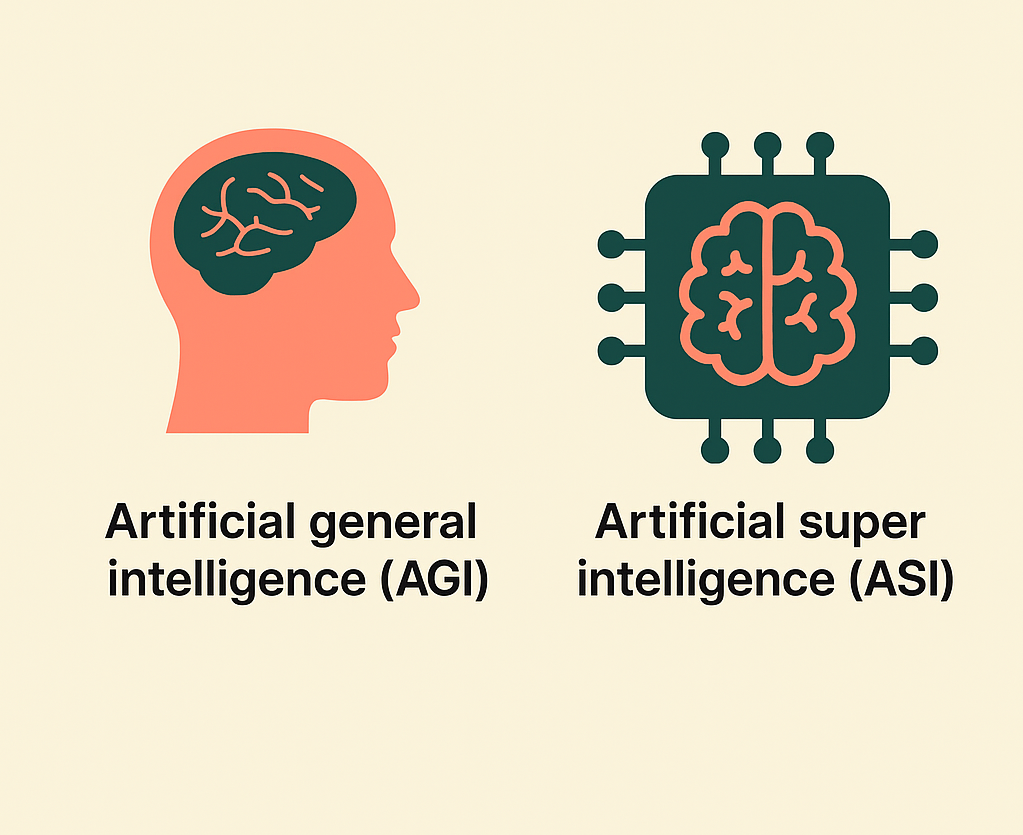
Here's what's happening: AI systems are progressing through three escalating stages—ANI (narrow), AGI (general), and ASI (super-intelligence). While artificial general intelligence (AGI) once felt like the end-game, leaders now treat it as a short layover on the flight to artificial superintelligence (ASI). The ability to learn continuously is what distinguishes AGI from narrow AI, and achieving AGI requires AI models that can generalize across domains—a challenge that leading AI labs are tackling through large-scale training and frontier AI research.
The path to reaching AGI involves solving fundamental problems in computer science, including reasoning, planning, and the ability to learn from limited examples. AI researchers are exploring how large language models can evolve into systems capable of artificial general intelligence, with some AI scientists predicting we'll reach AGI within the next few years.
Quick Timeline:
- ANI (Now): AI excels at specific tasks (GPT-4, Claude, Gemini)
- AGI (2025-2026): AI matches human intelligence across all domains
- ASI (2026-2027): AI exceeds the combined intelligence of all humans
This article unpacks the latest forecasts, explains what each stage means for your business, and provides concrete action steps for builders, policymakers, and career-changers.
What You'll Learn:
- Latest ASI timeline predictions from AI leaders
- How to prepare your business for super-intelligence
- Career strategies for the ASI transition
- Policy implications and governance frameworks
For a cost-cutting playbook on small language models (SLMs) inside agents, see our companion guide: Small Language Models vs Large Language Models.
For practical AI implementation strategies:
- AI Agent Orchestration: Multi-Agent Systems That Actually Work
- Context Engineering vs Prompt Engineering: The 2025 Guide
- Production-Ready AI Agent Architecture for enterprise deployments
- The Road to AGI: A Simple Guide for understanding AGI progression
1. Understanding the ANI → AGI → ASI Progression
| Capability Tier | Core Skill Set | Example System | Strategic Leap |
|---|---|---|---|
| ANI (Narrow) | One task well | GPT-4 Vision classifies images; AlphaFold folds proteins | Automates specialist labour |
| AGI (General) | Broad task coverage at human-level | Future model passes medical, legal & coding exams and self-fine-tunes | Substitutes most cognitive labour |
| ASI (Super) | Far exceeds best human teams in speed, creativity, strategy | Recursive-self-improving cluster coordinating millions of agents | Out-innovates, out-strategises & potentially out-governs humanity |
ASI ≠ "just a bigger model."
It is an emergent phase change where intelligence scales faster than we can comprehend, potentially leading to decisive technological, economic and even geopolitical advantage. Artificial superintelligence (ASI) represents a fundamental shift where AI systems exceed human capabilities across all domains, raising important questions about existential risk and the need for responsible development.
Leading AI labs recognize that achieving AGI is just the beginning. Once we reach AGI, the path to artificial superintelligence (ASI) may be shorter than many anticipate. AI researchers working at frontier AI organizations understand that large-scale deployment of advanced AI models requires careful consideration of safety and alignment challenges.
2. Why ASI Timelines Are Compressing: 2025 AI AGI ASI Latest News
The 2025 AI AGI ASI latest news reveals accelerating progress across multiple dimensions. A single month of headlines now tells the entire story, with leading AI labs and AI researchers providing increasingly specific timelines for achieving AGI and reaching ASI milestones.
- "We’re quite close to digital super-intelligence, if it doesn’t happen this year, next year for sure." - Elon Musk at AI Startup School, San Francisco Link
- "We are past the event horizon; the take-off has started." - Sam Altman, The Gentle Singularity blog post Link
- "AI will one day do all the things we can." - Ilya Sutskever, University of Toronto convocation Link
- "AGI could be five to ten years away … nothing short of a new Industrial Revolution." - Demis Hassabis interview Link
- "Scaling LLMs alone won’t get us there; we still need common-sense physics and planning." - Yann LeCun podcast clip Link
- "AI could eliminate up to 50 % of entry-level white-collar jobs within five years, driving unemployment to 20 %." - Dario Amodei, Business Insider round-table Link
Taken together, these remarks compress the "sci-fi horizon" into an executive planning window measured in quarters, not decades. Investors are pricing multi-year bets on frontier-model clusters; regulators are drafting export controls centred on total training compute; start-ups are pivoting from "add GPT" to "build an ASI-resilient stack."
If artificial general intelligence (AGI) is the moment machines can perform any cognitive job as well as an expert human, artificial superintelligence (ASI) is the inflection point where machines outperform the entire labour market in aggregate speed and originality. June 2025's commentary makes it clear: many AI researchers and AI scientists now believe that inflection could be reached inside the same budget cycle that brings Apple's M4 chips or Nvidia's Blackwell boards to market.
2.1 The Role of Leading AI Labs in Accelerating Timelines
Leading AI labs including OpenAI, DeepMind, Anthropic, and Meta's AI Research division are driving rapid progress toward achieving AGI. These frontier AI organizations are investing billions in large-scale training runs, pushing the boundaries of what's possible with large language models and AI models. The competition between these leading AI labs has compressed timelines significantly, with each breakthrough accelerating the path to reaching AGI.
Key factors from leading AI labs:
- OpenAI: Focused on scaling large language models and advancing toward AGI through iterative improvement
- DeepMind: Exploring novel architectures and the ability to learn across domains
- Anthropic: Emphasizing safety and alignment while advancing AI capabilities
- Frontier AI research: Cross-pollination of ideas accelerates progress across all labs
2.2 AI Researchers' Consensus on Timeline Compression
AI researchers across computer science departments and industry labs are converging on shorter timelines. The consensus among AI scientists working on frontier AI systems is that achieving AGI may happen sooner than previously thought. This shift reflects:
- Improved understanding of scaling laws and how to advance AI effectively
- Better architectures that enable AI systems to learn more efficiently
- Large-scale resources available to leading AI labs for training advanced AI models
- Cross-disciplinary collaboration between AI researchers, computer science experts, and domain specialists
The ability to learn from diverse data sources and generalize across tasks is improving rapidly, bringing us closer to reaching AGI milestones that once seemed decades away.
3. The 5 Accelerating Forces Driving ASI Development
Leading AI labs are leveraging multiple accelerating forces to advance AI toward artificial general intelligence (AGI) and artificial superintelligence (ASI). These forces work together to compress timelines and bring us closer to achieving AGI. Here's how AI researchers and AI scientists are pushing the boundaries:
3.1 Hardware & Scaling Laws
The cost-per-token of state-of-the-art AI models keeps falling by ~60 % each year. Nvidia's latest Blackwell GPUs and AMD's MI350X accelerators push per-card throughput beyond 1 × 10¹⁸ FLOPs/sec. Empirical scaling curves (compute × data × parameters) still deliver predictable jumps in capability, so every fresh cap-ex tranche is a step toward super-human composite IQ.
Leading AI labs are conducting large-scale training runs that leverage these hardware advances. Frontier AI organizations understand that achieving AGI requires massive computational resources, and they're investing heavily in infrastructure that enables training of ever-larger AI models. The ability to scale efficiently is crucial for reaching AGI, and computer science research continues to optimize these processes.
3.2 Synthetic & Self-Generated Data
Training runs no longer depend solely on scraped internet text. Systems like GPT-Self-Play, DeepMind's Gemini Generator, and Anthropic's Claude Tutor chain produce terabytes of high-fidelity synthetic problems and solutions closing edge-case gaps faster than humans can label them. More data means better generalisation, which tightens the spiral toward ASI-level reasoning.
AI researchers at leading AI labs are developing AI systems with enhanced ability to learn from synthetic data. This large-scale data generation enables AI models to improve their ability to learn across domains, bringing us closer to achieving AGI. The frontier AI approach involves creating training data that challenges AI models in ways that mirror real-world complexity, accelerating progress toward artificial general intelligence.
3.3 Algorithmic Breakthroughs
Chain-of-thought prompting, function-calling APIs and self-repair loops let AI models debug their own failures mid-inference. Add retrieval-augmented generation (RAG) and modular SLM swarms (see our SLM vs LLM guide) and you get architectures that learn continuously while slashing cost and latency. Advanced RAG systems and multi-agent orchestration enable these continuous learning architectures.
AI scientists working at frontier AI organizations are developing algorithms that enhance the ability to learn from limited examples—a key requirement for achieving AGI. These breakthroughs in computer science enable AI systems to generalize better, bringing us closer to reaching AGI. Leading AI labs are sharing research that advances AI capabilities across multiple dimensions, accelerating progress toward artificial general intelligence.
3.4 Embodiment & Edge Deployment
DeepMind's Gemini Robotics On-Device demo proved that frontier-level cognition can live on the robot itself, not just the cloud. Once AI models control sensors, actuators and local memory in real time, recursive-self-improvement gains a physical dimension: robots building better robots.
This embodiment research at leading AI labs demonstrates how AI systems can develop the ability to learn from physical interaction, advancing toward artificial general intelligence. Frontier AI research in robotics shows that achieving AGI may require systems that can learn from both digital and physical environments, expanding the scope of what AI models can accomplish.
3.5 Capital & Talent Squeeze
2025 Q2 venture filings show > $40 B poured into "ASI-readiness" from Meta's 49 % stake in Scale AI to sovereign-wealth–backed fabs in the Middle East. The "talent graph" has moved: alignment researchers command crypto-CEO salaries, and government agencies raid foundation-model labs to staff AI-safety task-forces.
Leading AI labs are attracting top AI researchers and AI scientists from computer science departments worldwide. This talent concentration accelerates progress toward achieving AGI, as the best minds collaborate on frontier AI challenges. The competition for AI researchers who can advance AI capabilities is intense, with leading AI labs offering unprecedented resources to support large-scale research efforts.
3.6 Governance Lag and Existential Risk Considerations
While Musk talks "truth-seeking audits" and Altman suggests a CERN-for-AI, most national rules still trail GPT-4-era risk models. The mismatch between capability velocity and policy cadence pushes builders to race ahead exactly the dynamic every leader, including the most cautious, now cites as the biggest existential variable.
AI researchers and AI scientists at leading AI labs recognize that achieving AGI and advancing toward artificial superintelligence (ASI) raises important questions about existential risk. As we get closer to reaching AGI, frontier AI organizations must balance rapid progress with safety considerations. The large-scale deployment of advanced AI systems requires careful governance to mitigate potential risks while enabling beneficial applications.
Key existential risk factors:
- Rapid capability growth: AI systems advancing faster than safety measures can keep pace
- Large-scale deployment: Widespread use of powerful AI models before full understanding
- Alignment challenges: Ensuring AI systems pursue goals aligned with human values
- Governance gaps: Policy and regulation lagging behind technical progress
Leading AI labs are investing in alignment research, recognizing that achieving AGI safely requires solving fundamental challenges in AI safety and control.
Bottom line: hardware ramps, data generation, new algorithms, embodied agents, and record-breaking investment all reinforce each other. The path from artificial general intelligence (AGI) → artificial superintelligence (ASI) no longer hinges on one breakthrough; it's a convergence of accelerating flywheels already in motion. Leading AI labs, AI researchers, and AI scientists are working together to advance AI capabilities, bringing us closer to achieving AGI and reaching AGI milestones that will reshape our world.
4. How to Prepare Your Business for ASI
| Feature | AGI-Ready Stack | ASI-Ready Upgrade |
|---|---|---|
| Inference Layer | Cloud LLM + plugins | Hybrid: on-device SLM swarm orchestrated by one frontier model |
| Safety Guardrails | RL-HF + content filters | Constitutional AI + formal verification + red-team simulators |
| Data Governance | PII masking, audit logs | Real-time anomaly detection, provable provenance |
| Latency Budget | Seconds OK | Sub-second to stay human-in-the-loop |
| Compute Footprint | Multi-GPU per request | Energy-aware routing (edge ↔ cloud) |
| Skill Updates | Periodic fine-tunes | Continual online learning with rollback checkpoints |
For a deep dive into cutting 10 – 30 × inference cost with SLMs, read our SLM vs LLM guide.
5. AI Leader Forecasts Comparison: 2025 AI AGI ASI Latest News
The 2025 AI AGI ASI latest news includes detailed forecasts from leading AI labs and prominent AI researchers. Here's how key AI scientists and leaders predict the path to achieving AGI and reaching AGI milestones:
| Leader | Forecasts (ANI → AGI → ASI) | Preferred Safety Play | Quote Highlight |
|---|---|---|---|
| Musk | ANI → AGI now → ASI by 2026 | Truth-seeking alignment, open-source audits | "A thousand-foot AI wave." |
| Altman | ANI → AGI crossed → ASI in < 24 m | Gradual release, societal co-evolution | "Gentle singularity." |
| Sutskever | ANI → AGI soon → ASI this decade | Safety leads capability at SSI | "AI will replicate every human ability." |
| Hassabis | ANI → AGI 2030ish → ASI later | International governance | "New Industrial Revolution." |
| LeCun | ANI → AGI 'needs missing pieces' → ASI later | Open research, robust world-models | "Scaling alone won't get us there." |
5.1 Insights from Leading AI Labs
OpenAI (Sam Altman, Ilya Sutskever):
- Leading AI lab focused on achieving AGI through iterative scaling
- AI researchers at OpenAI believe we're close to reaching AGI
- Emphasis on safety while advancing AI capabilities
- Large-scale training runs pushing boundaries of large language models
DeepMind (Demis Hassabis):
- Frontier AI organization exploring novel approaches to artificial general intelligence
- AI scientists developing systems with enhanced ability to learn
- Focus on solving fundamental problems in computer science
- More conservative timeline but significant progress expected
Anthropic:
- Leading AI lab balancing capability advancement with safety
- AI researchers developing constitutional AI approaches
- Recognition of existential risk while advancing toward AGI
- Focus on alignment research alongside capability development
5.2 Consensus Among AI Researchers
While timelines vary, there's growing consensus among AI researchers and AI scientists that:
- Achieving AGI is a matter of years, not decades
- Reaching AGI will require solving key challenges in reasoning and generalization
- Large language models are a stepping stone, not the endpoint
- Frontier AI research is accelerating progress across all leading AI labs
- Large-scale resources are essential for advancing AI toward artificial general intelligence
6. Immediate Actions for Different Roles
| Persona | Do Now | 12-Month Win |
|---|---|---|
| Startup CTO | Rewrite micro-services to call 7-B SLMs first; call big model only for synthesis. | 90 % cost drop, faster UX. |
| Enterprise CIO | Pilot DeepMind's on-device Gemini in secure doc workflows. | Cloud egress fees ↓, IP stays on-prem. |
| Policy-maker | Draft compute-threshold export rules keyed to ASI risk factors. | Early control levers before models go open-weight. |
| Educator | Shift curriculum toward prompting, oversight & ethics. | Students relevant post-AGI. |
| AI Safety Researcher | Join SSI's benchmark leaderboard; stress-test ASI failure modes. | Alignment techniques scale with capability. |
7. Key Metrics and Anti-Patterns to Track
Success Metrics to Track
AI Cost Optimization:
- AI cost reduction (target: 90% with SLM-first design)
- Token efficiency per business function
- Cloud vs edge deployment cost analysis
Safety and Compliance:
- Safety compliance score (target: 100% for critical workflows)
- ASI readiness score (target: 80%+ across business lines)
- Alignment validation pass rate
Career and Skills:
- Career future-proofing (target: AI-first role or skill set)
- Team AI literacy percentage
- Automation-resistant skill development
Common Anti-Patterns to Avoid
Technical Debt:
- "Dump the whole PDF"—optimize context, not token bloat
- Stale vector indexes—re-embed after major doc updates
- Context leakage across agents—add PII filtering
- No safety guardrails—validate all output schemas
- Ignoring context freshness or too-static strategies
Strategic Mistakes:
- Waiting for "perfect" ASI before preparing
- Ignoring safety considerations for speed
- Underestimating timeline compression
- Failing to build ASI-resilient architectures
Conclusion
The bottom line: ASI timelines have compressed from decades to months, with leaders predicting super-intelligence within 12-24 months. Your next career move or product launch should assume ASI could appear within your planning horizon.
Your next steps:
- Week 1: Assess your current AI readiness using the framework above
- Week 2: Implement SLM-first architecture for cost optimization
- Week 3: Build safety guardrails and compliance frameworks
- Week 4: Plan for ASI-era business models and career strategies
Key success metrics to track:
- AI cost reduction (target: 90% with SLM-first approach)
- Safety compliance score (target: 100% for critical systems)
- ASI readiness score (target: 80%+ across all business functions)
- Career future-proofing (target: AI-first role or skill set)
Five Critical Takeaways:
- Achieving AGI is a waypoint, not a finish line - Artificial superintelligence (ASI) is the real goal, and leading AI labs are working toward reaching AGI as a stepping stone
- ASI timelines are compressing - The most bullish estimates from AI researchers speak in months, with frontier AI organizations accelerating progress
- Safety philosophies diverge - But everyone agrees alignment research is non-negotiable, especially given existential risk considerations
- Cost & latency pressure - Make small language models and on-device inference your default, as large-scale deployment requires efficiency
- Plan for ASI now - Your next career move should assume super-intelligence is coming, as AI systems continue to advance rapidly
The Path Forward: What AI Researchers Are Saying
AI scientists and AI researchers across leading AI labs agree that we're in an unprecedented period of acceleration. The 2025 AI AGI ASI latest news reflects a convergence of factors:
- Large language models are becoming more capable, bringing us closer to artificial general intelligence
- AI models are developing enhanced ability to learn across domains
- Frontier AI research is solving fundamental problems in computer science
- Leading AI labs are collaborating and competing to advance AI capabilities
The consensus among AI researchers is clear: achieving AGI is no longer a distant possibility, and reaching AGI milestones will reshape industries, economies, and society. As we advance toward artificial superintelligence (ASI), the work of AI scientists and the research from leading AI labs will determine how quickly we reach these transformative milestones.
Ready or not, the intelligence curve is steepening. The prudent path is to build, learn and guard-rail simultaneously.
References & Further Reading
- Forbes: AGI and AI Superintelligence 2025
- AI Multiple: AGI/Singularity Timing—Global Expert Survey
- Binance: 20 Top AI Experts Predict AGI/ASI
- Nathan Benaich AI Guide Newsletter
- Alan's AGI Countdown
- AutoGPT: Best AI for Research in 2025
- Synthesia: Top 45 AI Tools
- The AI Report: Investment & Safety Initiatives
- Elon Musk — "Digital Super-Intelligence, Multiplanetary Life, How to Be Useful"(AI Startup School fireside)
- Sam Altman — "The Gentle Singularity"
- Ilya Sutskever — Convocation Address, University of Toronto
- Demis Hassabis Interview (Business Today)
- Dario Amodei Round-Table on Future Jobs (Business Insider)
- DeepMind — "Gemini Robotics On-Device" (DeepMind Blog)
- Meta's 49 % Stake in Scale AI & New Super-Intelligence Team (Wall Street Journal)
- Advantages of Context Engineering Over Prompt Engineering: Complete 2025 Guide & Best Practices
- Claude Skills: The New AI Agent Capabilities
- 10 Best Practices for Reliable AI Agent Systems
- Choosing Your Vector Database: Pinecone vs. Weaviate vs. Chroma
Frequently Asked Questions
Tags
Related Articles
Try Our Free Tools
AI Video Prompt Generator
Generate production-ready AI video prompts through conversation. Optimized for Sora 2 and Gemini video generation
AI Video Analyzer
Analyze video content frame-by-frame with AI. Content moderation, security monitoring, accessibility, and product demos
Text Language Detector & Translator
Detect any language and translate text instantly with browser-based AI