ElevenLabs Scribe v2 Realtime: The Most Accurate Real-Time Speech-to-Text Model
Discover Scribe v2 Realtime—ElevenLabs' breakthrough real-time Speech-to-Text model with 150ms latency, 90+ language support, and state-of-the-art accuracy for voice agents and live applications.
Summarize with:
Introduction
ElevenLabs has launched Scribe v2 Realtime—the most accurate real-time Speech-to-Text model. Built specifically for voice agents, meeting notetakers, and live applications, Scribe v2 Realtime transcribes speech in just 150ms across 90+ languages, setting a new standard for low-latency ASR accuracy.
Here's what makes it revolutionary: Scribe v2 Realtime outperforms every other low-latency ASR model on hard samples containing background noise and complex information. It's specifically engineered for agentic use cases where accuracy and speed are critical.
Quick Results:
- 150ms latency, faster than human typing speed
- State-of-the-art accuracy on challenging audio samples
- 90+ language coverage including English, French, German, Italian, Spanish, Portuguese, Hindi, and Japanese
- Enterprise-grade compliance: SOC 2, ISO27001, PCI DSS L1, HIPAA, GDPR
- EU & India data residency options
- Zero retention mode for privacy-sensitive applications
This guide explores Scribe v2 Realtime's capabilities, use cases, and how it transforms real-time speech processing for modern AI applications.
What You'll Learn:
- Scribe v2 Realtime's breakthrough accuracy and performance
- Real-world applications for voice agents and meeting assistants
- Integration strategies for production deployments
- Enterprise compliance and security features
- Comparison with existing ASR solutions
For building production-ready voice agents, see our guides on meeting assistant agents and production-ready AI agent architecture.
1. Understanding Scribe v2 Realtime's Breakthrough Performance
1.1 The Real-Time ASR Challenge
Real-time Speech-to-Text has always faced a fundamental trade-off: speed versus accuracy. Traditional ASR models either:
- Prioritized accuracy but required several seconds of processing (too slow for live applications)
- Prioritized speed but struggled with background noise, accents, or complex vocabulary (too inaccurate for production use)
Scribe v2 Realtime breaks this trade-off by delivering both state-of-the-art accuracy and sub-200ms latency—fast enough for natural conversation flow.
1.2 What Makes Scribe v2 Realtime Different
| Feature | Scribe v2 Realtime | Traditional Real-Time ASR | Batch ASR Models |
|---|---|---|---|
| Latency | ~150ms | Typically 200-500ms+ | Several seconds |
| Accuracy (Clean Audio) | State-of-the-art | Varies by provider | High accuracy |
| Accuracy (Noisy Audio) | Significantly outperforms all low-latency models | Lower accuracy on challenging samples | Better but not real-time |
| Language Support | 90+ languages | Varies (typically 20-50) | Varies (typically 50-100) |
| Use Case Fit | Real-time agents, live transcription | Basic real-time transcription | Post-meeting analysis, content processing |
Key Differentiator: According to ElevenLabs, on hard samples containing background noise and complex information, Scribe v2 Realtime significantly outperforms all other low-latency ASR models. This makes it ideal for production voice agents where accuracy directly impacts user experience and business outcomes.
1.3 Technical Specifications
- Latency: ~150ms (end-to-end)
- Languages: 90+ languages supported
- Accuracy: State-of-the-art on challenging audio samples
- Concurrency: Higher limits than other ElevenLabs services
- Compliance: SOC 2, ISO27001, PCI DSS L1, HIPAA, GDPR
- Data Residency: EU & India options available
- Privacy: Zero retention mode supported
2. Real-World Applications: Where Scribe v2 Realtime Excels
2.1 Voice Agents and Conversational AI
The Problem: Voice agents need to understand user speech accurately and quickly to maintain natural conversation flow. Even small transcription errors can derail the entire interaction.
How Scribe v2 Realtime Solves It:
- 150ms latency means users don't experience awkward pauses
- High accuracy on noisy audio ensures reliable performance in real-world environments (phone calls, video calls, noisy offices)
- 90+ language support enables global deployment without separate models
Real-World Impact:
- Customer support agents that understand callers accurately, even with background noise
- Sales agents that capture product requirements correctly on the first try
- Voice assistants that respond naturally without interrupting user flow
For building production voice agents, see our guide on voice agent architecture patterns.
2.2 Meeting Assistants and Live Notetaking
The Problem: Meeting assistants need to transcribe conversations in real-time while maintaining accuracy across multiple speakers, background noise, and technical vocabulary.
How Scribe v2 Realtime Solves It:
- Real-time transcription enables live note-taking and action item extraction
- High accuracy on complex information ensures technical terms and names are captured correctly
- Low latency allows for immediate follow-up questions and clarifications
Real-World Impact:
- Live meeting transcripts available immediately after the meeting ends
- Real-time action item extraction and decision tracking
- Instant searchability of meeting content for participants
For comprehensive meeting assistant implementation, see our guide on meeting assistant agents with real-time processing.
2.3 Live Broadcasting and Content Creation
The Problem: Content creators need accurate real-time captions for live streams, but traditional ASR struggles with fast speech, accents, and domain-specific terminology.
How Scribe v2 Realtime Solves It:
- State-of-the-art accuracy handles fast speech and accents better than competitors
- Low latency enables real-time captioning without noticeable delay
- 90+ language support supports multilingual content creators
Real-World Impact:
- Live streaming platforms with accurate real-time captions
- Podcast production with instant transcription
- Multilingual content creation workflows
3. Integration Strategies: Building with Scribe v2 Realtime
3.1 API Integration
Scribe v2 Realtime is available through ElevenLabs' Speech-to-Text API. The integration follows a standard streaming pattern:
Basic Integration Flow:
- Initialize Connection: Establish WebSocket connection to ElevenLabs API
- Stream Audio: Send audio chunks in real-time (typically 20-50ms chunks)
- Receive Transcripts: Process transcription results as they arrive (~150ms latency)
- Handle Errors: Implement retry logic and error handling for production reliability
Key Considerations:
- Audio Format: Supports multiple audio formats (check ElevenLabs documentation for current supported formats)
- Chunking Strategy: Optimal chunk size balances latency and accuracy
- Error Handling: Network interruptions require reconnection logic
- Rate Limiting: Respect API rate limits as specified in your account
For production-ready implementations, follow best practices for reliable AI agents.
3.2 ElevenLabs Agents Platform Integration
Simplified Integration: Scribe v2 Realtime is also available directly within ElevenLabs Agents, providing a complete voice agent solution without managing ASR infrastructure.
Benefits:
- Pre-configured: ASR, TTS, and LLM orchestration handled automatically
- Natural Conversations: Optimized for human-sounding agent interactions
- Built-in Features: Additional features available (check ElevenLabs Agents documentation for current capabilities)
Use Cases:
- Customer support agents
- Sales qualification bots
- In-product voice experiences
When to Use Agents vs. API:
- Use Agents Platform: When you want a complete voice agent solution without infrastructure management
- Use API Directly: When you need custom orchestration, existing LLM infrastructure, or specific workflow control
4. Enterprise Compliance and Security
4.1 Compliance Certifications
Scribe v2 Realtime meets enterprise-grade compliance requirements:
- SOC 2 Type II: Security and availability controls verified
- ISO27001: Information security management system certified
- PCI DSS Level 1: Payment card data security standards
- HIPAA: Healthcare data protection (requires BAA agreement)
- GDPR: European data protection regulation compliance
Important Note: Companies requiring HIPAA compliance must contact ElevenLabs Sales to sign a Business Associate Agreement (BAA) before proceeding with HIPAA-related integrations.
4.2 Data Residency and Privacy
Data Residency Options:
- EU Residency: Process and store data within European Union boundaries
- India Residency: Process and store data within India
- Default: US-based processing (check current options with ElevenLabs)
Zero Retention Mode:
- Process audio without storing transcripts or audio files
- Ideal for privacy-sensitive applications
- Transcripts generated but not persisted after processing
Privacy Considerations:
- Review ElevenLabs' data retention policies
- Configure appropriate retention periods for your use case
- Implement data classification and access controls
For enterprise security best practices, see our guide on production-ready AI agent architecture.
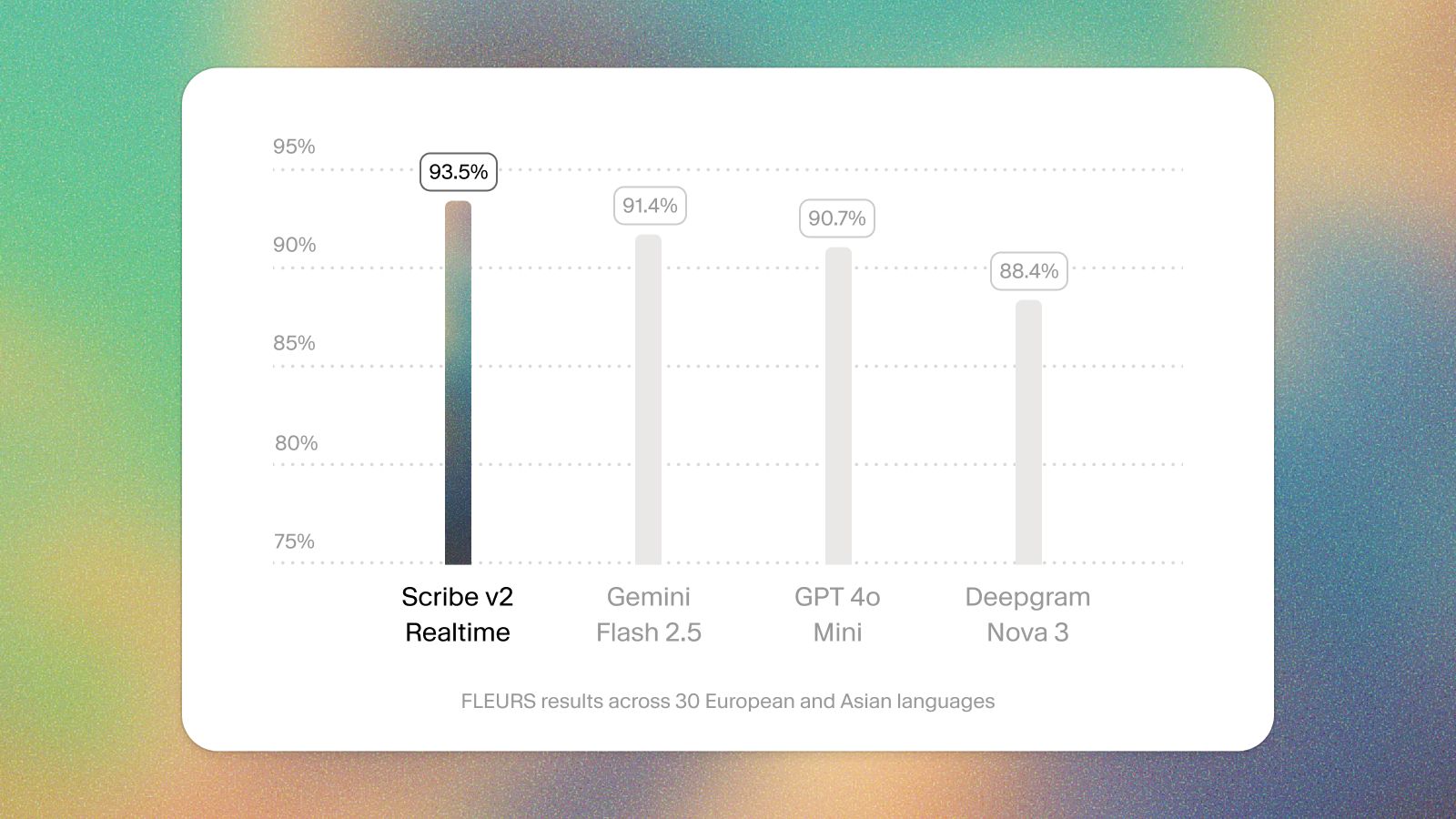
5. Performance Comparison: Scribe v2 Realtime vs. Alternatives
5.1 Accuracy Comparison
On Clean Audio:
- Scribe v2 Realtime: State-of-the-art accuracy
- Traditional Real-Time ASR: Good accuracy
- Batch ASR Models: Excellent accuracy (but 2-10 second latency)
On Noisy Audio (Key Differentiator):
- Scribe v2 Realtime: Significantly outperforms all other low-latency models
- Traditional Real-Time ASR: Moderate accuracy degradation
- Batch ASR Models: Good accuracy but unusable for real-time
On Complex Information:
- Scribe v2 Realtime: Handles technical terms, names, and domain-specific vocabulary better than competitors
- Traditional Real-Time ASR: Struggles with specialized vocabulary
- Batch ASR Models: Good but requires post-processing delay
5.2 Latency Comparison
| Model Type | Typical Latency | Use Case Fit |
|---|---|---|
| Scribe v2 Realtime | ~150ms | Real-time agents, live transcription |
| Traditional Real-Time ASR | 200-500ms | Basic real-time transcription |
| Batch ASR Models | 2-10 seconds | Post-meeting analysis, content processing |
Why Latency Matters:
- Under 200ms: Feels natural and responsive (Scribe v2 Realtime)
- 200-500ms: Noticeable but acceptable for most use cases
- Over 500ms: Feels slow and can disrupt conversation flow
- Over 2 seconds: Unusable for real-time applications
5.3 Language Support Comparison
Scribe v2 Realtime: 90+ languages including:
- European: English, French, German, Italian, Spanish, Portuguese, Dutch, Polish, Russian, and more
- Asian: Hindi, Japanese, Mandarin, Korean, Thai, Vietnamese, and more
- Middle Eastern: Arabic, Hebrew, Persian, Turkish, and more
- African: Swahili, Afrikaans, and more
Competitive Advantage: Broader language coverage than most real-time ASR solutions, enabling global deployment without multiple providers.
6. Getting Started: Implementation Guide
6.1 Step 1: Sign Up and Get API Access
- Sign up for ElevenLabs: Get started with Scribe v2 Realtime
- Get API Key: Generate your API key from the ElevenLabs dashboard
- Review Documentation: Familiarize yourself with the Speech-to-Text API documentation
6.2 Step 2: Choose Your Integration Path
Option A: Direct API Integration
- Full control over audio processing and LLM orchestration
- Best for: Custom workflows, existing infrastructure, specific requirements
Option B: ElevenLabs Agents Platform
- Pre-configured voice agent solution
- Best for: Quick deployment, complete voice agent needs, minimal infrastructure
6.3 Step 3: Implement Basic Transcription
Example Use Case: Real-Time Meeting Transcription
// Pseudocode example - adapt to your stack
class RealtimeTranscription {
  private websocket: WebSocket;
  private audioStream: MediaStream;

  async startTranscription() {
    // 1. Initialize WebSocket connection
    this.websocket = new WebSocket('wss://api.elevenlabs.io/v1/speech-to-text');

    // 2. Send audio chunks
    this.audioStream.getTracks()[0].on('data', (audioChunk) => {
      this.websocket.send(audioChunk);
    });

    // 3. Receive transcripts
    this.websocket.on('message', (transcript) => {
      this.handleTranscript(transcript);
    });
  }

  handleTranscript(transcript: Transcript) {
    // Process transcript in real-time
    // ~150ms latency from speech to text
  }
}
6.4 Step 4: Production Considerations
Error Handling:
- Implement reconnection logic for network interruptions
- Handle API rate limits gracefully
- Monitor transcription quality and accuracy
- Implement comprehensive error handling and fallback strategies
Performance Optimization:
- Optimize audio chunk size for your use case
- Implement caching for repeated phrases or common responses
- Monitor latency and adjust processing pipeline as needed
Security:
- Secure API key storage (never commit to version control)
- Implement access controls for transcription data
- Configure appropriate data retention policies
For production best practices, see 10 best practices for reliable AI agents.
7. Use Case Deep Dive: Voice Agents
7.1 Why Scribe v2 Realtime is Ideal for Voice Agents
Voice agents require three critical capabilities:
- Fast transcription (under 200ms) to maintain natural conversation flow
- High accuracy to understand user intent correctly
- Robust performance on noisy audio and various accents
Scribe v2 Realtime delivers on all three, making it the optimal choice for production voice agents.
7.2 Architecture Pattern: Voice Agent with Scribe v2 Realtime
Key Components:
- Scribe v2 Realtime: Converts speech to text with ~150ms latency
- LLM Processing: Understands intent and generates responses
- Text-to-Speech: Converts responses back to speech
- Business Logic: Executes actions based on user intent
Total Latency Budget:
- ASR (Scribe v2 Realtime): ~150ms
- Additional processing (LLM, TTS, etc.): Varies based on your implementation
- Total: Depends on your full pipeline configuration
For comprehensive voice agent architecture, see agent architecture patterns for 2025.
8. Common Pitfalls and Best Practices
8.1 Common Pitfalls
1. Ignoring Audio Quality
- Problem: Poor audio quality degrades accuracy regardless of ASR model
- Solution: Implement audio preprocessing (noise reduction, normalization) before sending to API
2. Not Handling Network Interruptions
- Problem: WebSocket connections can drop, causing transcription failures
- Solution: Implement automatic reconnection with exponential backoff
3. Neglecting Error Handling
- Problem: API errors can crash the application
- Solution: Implement comprehensive error handling and fallback strategies
8.2 Best Practices
1. Optimize Audio Chunking
- Use 20-50ms audio chunks for optimal latency/accuracy balance
- Test different chunk sizes for your specific use case
2. Monitor Accuracy Metrics
- Track transcription quality for your audio samples
- Compare accuracy across different audio conditions (clean, noisy, accented)
3. Implement Caching
- Cache common phrases or responses to reduce API calls
- Use transcript caching for repeated audio segments
4. Plan for Scale
- Monitor API usage and performance metrics
- Implement scaling strategies for high-volume applications
- Optimize processing pipeline for efficiency
Conclusion
The bottom line: Scribe v2 Realtime sets a new standard for real-time Speech-to-Text, delivering state-of-the-art accuracy at ~150ms latency. It significantly outperforms other low-latency ASR models on challenging audio samples, making it ideal for production voice agents and live applications.
Key success metrics to track:
- Transcription latency (target: under 200ms)
- Accuracy on your audio samples
- User satisfaction with voice agent interactions
Scribe v2 Realtime represents a breakthrough in real-time ASR technology. By combining state-of-the-art accuracy with sub-200ms latency, it enables a new class of real-time voice applications that weren't previously possible.
Key Takeaways:
- Unmatched Accuracy: Significantly outperforms competitors on noisy and complex audio
- Ultra-Low Latency: ~150ms enables natural conversation flow
- Enterprise Ready: SOC 2, ISO27001, HIPAA, GDPR compliance with data residency options
- Global Support: 90+ languages enable worldwide deployment
- Production Proven: Built specifically for agentic use cases
The future of voice AI is real-time, accurate, and agentic. Scribe v2 Realtime makes that future available today.
References & Further Reading
- ElevenLabs Speech-to-Text Documentation
- ElevenLabs Agents Platform
- Meeting Assistant Agents with Real-Time Processing
- Production-Ready AI Agent Architecture
- Agent Architecture Patterns for 2025
- 10 Best Practices for Reliable AI Agents
- Context Engineering vs Prompt Engineering: The 2025 Guide
- AI Agent Orchestration: Multi-Agent Systems That Actually Work
- The Key Components of a Production-Ready AI Agent Architecture
- AI Agents in Content Marketing: The Future of SEO and Content Ideation
- OpenAI Atlas Browser: The Ultimate Guide to AI-Powered Browsing for Business Productivity
Frequently Asked Questions about Scribe v2 Realtime
Tags
Related Articles
Try Our Free Tools
AI Video Prompt Generator
Generate production-ready AI video prompts through conversation. Optimized for Sora 2 and Gemini video generation
AI Video Analyzer
Analyze video content frame-by-frame with AI. Content moderation, security monitoring, accessibility, and product demos
Text Language Detector & Translator
Detect any language and translate text instantly with browser-based AI