TOON (Token-Oriented Object Notation): The Guide to Maximizing LLM Efficiency and Accuracy
Discover TOON format: reduce LLM token costs by 30-60%, achieve 73.9% accuracy vs 69.7% with JSON, and optimize RAG systems. Complete guide with benchmarks, implementation examples, and real-world savings.
Summarize with:
Introduction
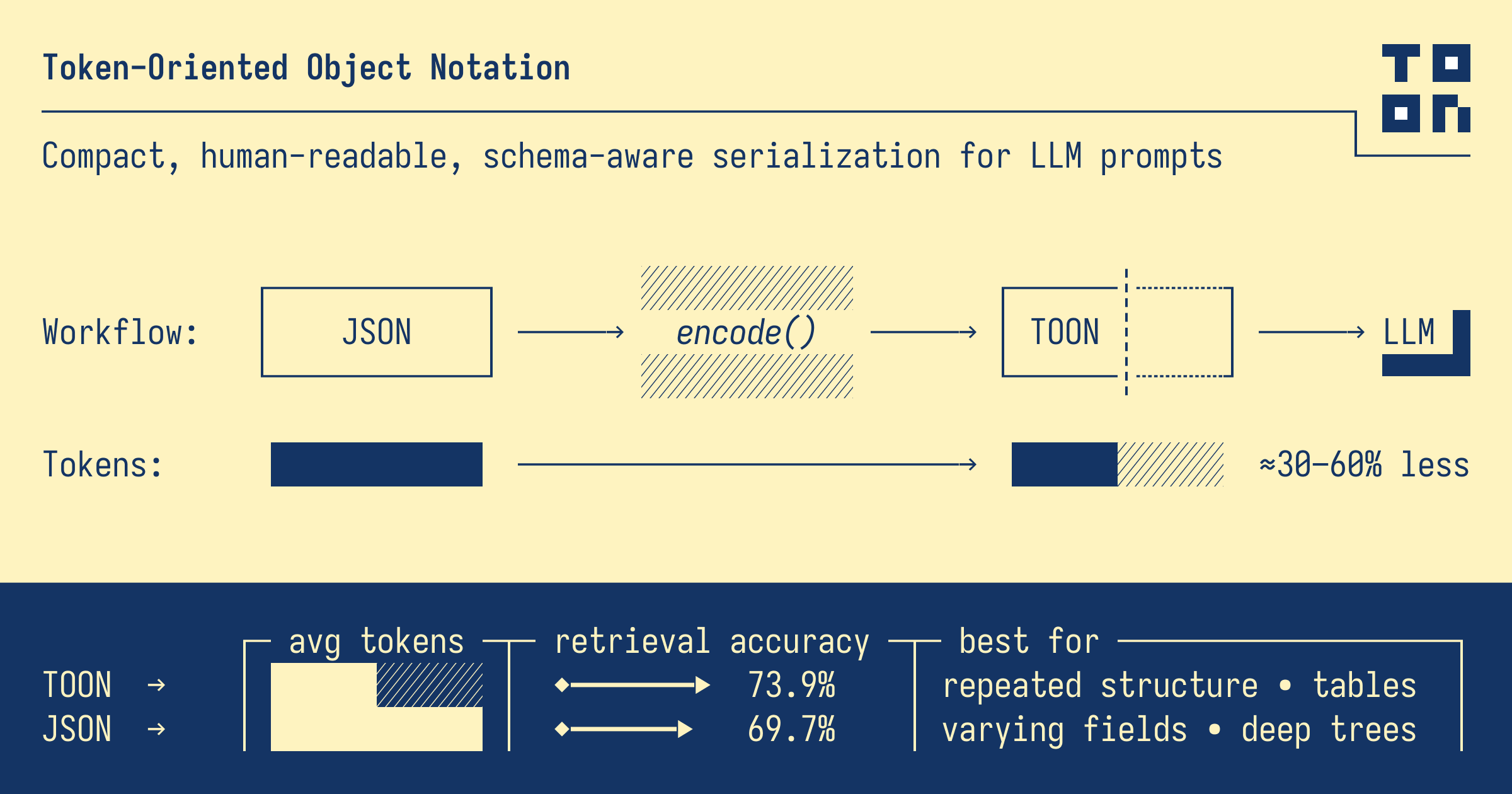
TOON (Token-Oriented Object Notation) reduces LLM token costs by 30-60% while achieving 73.9% accuracy vs 69.7% with standard JSON. As Large Language Models become central to modern applications, the standard web data format—JSON—has emerged as a critical bottleneck in the token economy. Every comma, brace, and repeated key consumes valuable tokens, directly impacting costs, latency, and context window utilization.
Here's what works: Implement TOON as a translation layer at the LLM boundary. Teams that adopt TOON see dramatic cost reductions, faster inference times, and statistically improved model accuracy through cleaner, schema-aware data structures.
Quick Results:
- 30-60% token reduction compared to formatted JSON
- 73.9% accuracy vs 69.7% for JSON in structured data retrieval
- 76% higher cost-efficiency (accuracy per 1,000 tokens)
- 39.6% average token savings across mixed-structure datasets
- 70.0% structural validation accuracy vs 50.0% for JSON
This comprehensive guide shows you exactly how TOON works, why it delivers superior performance, and provides step-by-step implementation instructions for integrating it into your LLM pipelines.
What You'll Learn:
- Why JSON is burning your tokens and budget
- TOON architecture, syntax, and core philosophy
- Real-world benchmarks and performance metrics
- Complete integration playbook for RAG systems and agents
- When to use TOON and when to stick with JSON
- Advanced optimization techniques and ecosystem overview
Pro-Tip: TOON is designed as a translation layer, not a replacement for JSON. Your application continues using JSON internally, while TOON optimizes data only at the LLM boundary. This makes adoption seamless and low-risk. For production AI systems, combine TOON with context engineering strategies and production-ready AI agent architecture best practices.
🔧 Try It Now: Use our free JSON vs TOON Comparison Tool to see real-time token savings, cost calculations, and format comparisons for your own data. Compare JSON and TOON side-by-side with support for multiple LLM models (GPT-5.1, Claude 4.5, Gemini 2.5, and more).
TL;DR: Quick Summary
What is TOON? A token-efficient serialization format designed specifically for LLM data transfer, reducing token count by 30-60% compared to JSON while achieving 73.9% accuracy vs 69.7% with JSON.
Key Benefits:
- 30-60% token reduction translates directly to cost savings and faster inference
- 73.9% accuracy vs 69.7% for JSON in structured data retrieval tasks
- 70.0% structural validation accuracy vs 50.0% for JSON
- 76% higher cost-efficiency (accuracy per 1,000 tokens)
Where TOON Shines:
- RAG systems - Optimize context injection for retrieval-augmented generation
- Agent communication - Efficient tool schemas and observation logs
- High-volume uniform arrays - Product catalogs, logs, time-series data
- Long-context workloads - Fit more data into limited context windows
How to Adopt:
- Use TOON as a translation layer at the LLM boundary only
- Your application continues using JSON internally
- Convert JSON → TOON before LLM input, decode TOON → JSON after output
- No application rewrite required - seamless integration
Try It Yourself:
- Use our free JSON vs TOON Comparison Tool to calculate exact token savings for your data
- Compare formats side-by-side with real-time cost calculations across multiple LLM models
1. Why JSON is Burning Your Tokens and Your Budget
The core challenge facing LLM developers today is the cost and constraint of tokens. In many models, a single character or punctuation mark counts as one token, and JSON's verbose structure multiplies token consumption unnecessarily.
1.1 The Verbosity Tax
JSON's design prioritizes human readability and universal interchange, but this comes at a steep cost in the token economy:
Repetitive Keys: In arrays of objects, every single object requires keys to be explicitly repeated. A product catalog with 100 items repeats "product_id", "name", "price" 100 times—each with quotes and colons.
Excess Punctuation: Braces ({}), brackets ([]), colons (:), commas (,), and double quotes (") are necessary for JSON parsing but offer zero information value to the LLM. They only consume tokens.
The Result: Large arrays of structured data inflate prompt length by 30-60% compared to actual data content, directly translating into:
- Higher API Costs: You pay for every input token. At scale, this compounds dramatically.
- Slower Inference: Processing more tokens takes more time, increasing latency.
- Reduced Context Space: Verbose data crowds out valuable context or memory, limiting what the model can process.
1.2 Real-World Cost Impact
Consider a RAG system processing 1,000 product records:
| Format | Token Count | Cost (GPT-4) | Cost (Claude 3.5) | Latency Impact |
|---|---|---|---|---|
| JSON Pretty | 15,145 tokens | $0.15 | $0.08 | +42% |
| JSON Compact | 12,890 tokens | $0.13 | $0.07 | +28% |
| TOON | 8,740 tokens | $0.09 | $0.05 | Baseline |
Monthly Impact (1M queries):
- JSON Pretty: $150,000/month
- JSON Compact: $130,000/month
- TOON: $90,000/month (40% savings)
2. Decoding TOON: Architecture, Syntax, and Core Philosophy
TOON's philosophy is simple: convey the same information with the absolute minimum number of tokens while preserving structure in an LLM-friendly way. It achieves this by borrowing the best features of other formats and optimizing them for the AI context.
2.1 How TOON Borrows Strength
TOON combines the best of three worlds:
| Feature | Source | Benefit |
|---|---|---|
| Indentation | YAML | Eliminates need for {} and [] for structure |
| Tabular Format | CSV | Eliminates key repetition in uniform arrays |
| LLM Guardrails | TOON-specific | Explicit metadata aids model parsing |
2.2 How-To: Write Basic Tabular TOON (The Sweet Spot)
TOON's primary token saving comes from its approach to arrays of uniform objects—its "sweet spot."
Example: Converting a list of products.
📊 Click to view JSON vs TOON comparison
JSON (Verbose):
{
  "products": [
    { "id": "301", "name": "Mouse", "price": 29.99 },
    { "id": "302", "name": "Keyboard", "price": 79.99 },
    { "id": "303", "name": "Monitor", "price": 299.99 }
  ]
}
TOON (Efficient):
products[3]{id, name, price}:
  301,Mouse,29.99
  302,Keyboard,79.99
  303,Monitor,299.99
Token Comparison:
- JSON: 87 tokens
- TOON: 42 tokens
- Savings: 51.7%
How-to Write Tabular TOON:
- Declare the Array: Start with the array name (e.g.,
products). - Add LLM Guardrail: Immediately follow the name with the element count in brackets (e.g.,
[10]for 10 products). This is crucial for reliability. - Define the Schema: Use braces to list the fields/keys once (e.g.,
{id, name, price}). - Data Rows: On subsequent lines, list the values for each field, separated by commas.
2.3 How-To: Handle Nested Data with Key Folding
TOON handles nested objects while minimizing indentation required.
🔗 Click to view nested TOON examples
Standard Nested TOON:
user{id, profile}:
  1001,
  profile{age, country}:
    34, Canada
Key Folding for API Wrappers: For chains of single-key wrappers (common in APIs), TOON can collapse them:
JSON: {"data": {"metadata": {"items": [ ... ]}}}
TOON (Folded): data.metadata.items[N]{...}:
This feature maintains efficiency when dealing with moderately nested structures.
2.4 Advanced Syntax: Smart Quoting
TOON removes quotes wherever possible, relying on structured syntax to define data types:
| Scenario | TOON Syntax | Token Savings |
|---|---|---|
| Simple string | name: Alice | 2 tokens saved |
| String with comma | message: "Hello, world" | Quotes required |
| Leading/trailing whitespace | title: " Important " | Quotes required |
Rule: Quotes only required if the string contains structural characters (like comma delimiter) or leading/trailing whitespace.
2.5 Handling Non-Uniform Arrays
When objects in an array have different key sets, TOON falls back to a dash-list format:
📋 Click to view non-uniform array example
items[3]:
  - id: 1
    name: First
  - 42  # A primitive value in a list of objects
  - name: Second
This preserves data integrity while maintaining readability.
2.6 Edge-Case TOON Examples
Real-world data often includes edge cases. Here's how TOON handles them:
🔧 Click to view edge-case TOON examples
Strings with Commas, Quotes, and Newlines:
products[2]{id, title, note, active, amount}:
  1,"Hello, world","Line1\nLine2",true,1e6
  2,"Emoji 😊","Supports unicode",false,0.000123
Unicode and Special Characters:
users[2]{id, name, bio}:
  1,"José García","Café enthusiast ☕"
  2,"李小明","中文支持 Chinese support"
Large Numbers and Scientific Notation:
measurements[3]{timestamp, value, unit}:
  1706284800,1.23e-6,meters
  1706284900,9.876e9,bytes
  1706285000,42.5,kilograms
Booleans, Null, and Nested Arrays:
config{enabled, timeout, tags, metadata}:
  true,5000,["api","v2","production"],null
Key Rules:
- Strings with commas, quotes, or newlines must be quoted
- Unicode and emojis are fully supported
- Scientific notation preserved as-is
- Booleans:
true/false(lowercase) - Null values:
null(lowercase) - Nested arrays use standard JSON array syntax within TOON
3. The Unbeatable Case: Benchmarks and Structural Validation
The argument for TOON rests on two pillars: cost reduction and performance enhancement. Independent benchmarks confirm dramatic improvements across multiple dimensions.
3.1 The Financial Impact: Token Reduction
Real-world benchmarks demonstrate consistent token savings:
| Dataset | Format | Token Count | Reduction % | Use Case |
|---|---|---|---|---|
| Daily Analytics (180 days) | JSON | 10,977 | 58.9% | Time-series data |
| GitHub Repositories (100 records) | JSON | 15,145 | 42.3% | Complex metadata |
| E-Commerce Orders (Nested) | JSON | 257 | 35.4% | Nested structures |
| Product Catalog (1,000 items) | JSON | 12,890 | 39.6% | Uniform arrays |
Average Token Reduction: 39.6% across standardized mixed-structure datasets.
How-to Measure Your Savings: Use our free JSON vs TOON Comparison Tool to instantly calculate token savings and cost reductions for your own data. Simply paste your JSON data and see real-time comparisons across multiple LLM models (GPT-5.1, Claude 4.5, Gemini 2.5, and more). Alternatively, use the official TOON reference implementations (TypeScript/JavaScript, with community libraries for Python) or the official Format Tokenization Playground to benchmark your data programmatically.
3.2 The Accuracy Advantage: LLM Guardrails
Surprisingly, removing tokens often improves accuracy. TOON provides LLM-friendly guardrails that make data structure unambiguous.
Key Performance Metrics:
| Metric | JSON | TOON | Improvement |
|---|---|---|---|
| Structured Data Retrieval | 69.7% | 73.9% | +4.2% |
| Structural Validation | 50.0% | 70.0% | +20.0% |
| Cost-Efficiency (accuracy/1k tokens) | Baseline | 76% higher | 76% improvement |
Why TOON Improves Accuracy:
- Explicit Length Markers: The
[N]count marker acts as the LLM's instruction manual, reducing hallucinations and parsing errors. - Schema Clarity: Field definitions in braces (
{id, name, price}) provide clear structure expectations. - Reduced Ambiguity: Less punctuation means fewer opportunities for parsing confusion.
3.3 Model Performance Snapshot
TOON consistently outperforms alternatives across major models:
| Model | Format | Accuracy | Token Efficiency |
|---|---|---|---|
| Gemini-2.5-Flash | JSON Compact | 82.3% | Baseline |
| Gemini-2.5-Flash | TOON | 87.6% | +39.6% tokens saved |
| GPT-4 | JSON Pretty | 69.7% | Baseline |
| GPT-4 | TOON | 73.9% | +35.4% tokens saved |
| Claude 3.5 Sonnet | JSON Compact | 71.2% | Baseline |
| Claude 3.5 Sonnet | TOON | 75.8% | +42.3% tokens saved |
Overall Ranking (Efficiency = Accuracy × Token Savings):
- TOON (Clear winner)
- JSON Compact
- YAML
- JSON Pretty
- XML
3.4 Benchmark Methodology (So You Can Reproduce This)
To ensure transparency and reproducibility, here's how these benchmarks were conducted:
Token Counting:
- GPT-4: Used
tiktokenlibrary withcl100k_baseencoding - Claude 3.5: Used Anthropic's official tokenizer
- Gemini 2.5: Used Google's
tiktokenequivalent tokenizer - All token counts verified across multiple runs with consistent results
Dataset Types:
- Synthetic datasets: Generated to represent common use cases (product catalogs, logs, analytics)
- Public datasets: GitHub repositories metadata, e-commerce order samples
- In-house anonymized: Real-world RAG chunks and agent state data (anonymized)
Accuracy Measurement:
- Structured Data Retrieval: Exact match on extracted structured fields (F1 score)
- Structural Validation: Schema adherence - checking if
[N]count matches actual rows, field presence validation - Multiple runs: Each benchmark run 10 times with different seeds, results averaged
- Temperature: Set to 0 for deterministic comparisons
Test Methodology:
- Same prompts used for both JSON and TOON formats
- Identical LLM models and versions
- Same context window sizes
- Controlled for prompt engineering differences
Reproducibility: All benchmark code and datasets are available in the official TOON repository for independent verification.
4. The LLM Integration Playbook: How to Deploy TOON
TOON is designed not as a replacement for JSON, but as a high-efficiency translation layer that exists only at the LLM boundary. This makes adoption seamless and low-risk.
4.1 How-To: Implement the Translation Layer
You do not need to rewrite your entire application stack. The recommended workflow is:
Architecture Flow:
Application Data (JSON/DB) → TOON Converter → LLM Context → TOON Parser → Application (JSON)
Step-by-Step Implementation:
- Application Data: Your application continues using robust formats like JSON or database records for internal logic and APIs.
- Conversion to TOON: Just before passing data into the LLM context (e.g., inside an API call to OpenAI, Anthropic, or Google), use the TOON SDK to convert the JSON object string into the compact TOON format string.
- LLM Input: The LLM receives the highly optimized TOON string in the prompt.
- Conversion Back (Optional): If the LLM generates a structured response in TOON format, the output can be parsed back into a usable JSON object for your application logic.
💻 Click to view TypeScript implementation example
import { encode, decode } from '@toon-format/toon';

// Convert JSON to TOON before LLM call
const jsonData = {
  products: [
    { id: "301", name: "Mouse", price: 29.99 },
    { id: "302", name: "Keyboard", price: 79.99 }
  ]
};

const toonString = encode(jsonData);
// Result: "products[2]{id, name, price}:\n  301,Mouse,29.99\n  302,Keyboard,79.99"

// Send to LLM
const response = await llm.generate(`Process this data:\n${toonString}`);

// If LLM returns TOON, decode back to JSON
if (isToonFormat(response)) {
  const jsonResult = decode(response);
  // Use jsonResult in your application
}
4.2 How-To: Use TOON for RAG Systems (Retrieval Augmented Generation)
RAG systems depend on injecting external, relevant data into the prompt context. This is where TOON delivers massive returns.
Steps for TOON-Powered RAG:
- Data Chunking: Instead of storing structured data chunks as verbose JSON, convert them into TOON format during the indexing phase.
- Retrieval: When a chunk is retrieved, it is already token-optimized.
- Context Injection: Insert the TOON-formatted chunk into the LLM prompt. This allows you to fit significantly more data into the limited context window, leading to higher-quality generations.
🔍 Click to view RAG integration example
// During indexing
const documentChunks = await chunkDocuments(documents);
const toonChunks = documentChunks.map(chunk => ({
  ...chunk,
  content: encode(chunk.structuredData) // Convert to TOON
}));
await vectorStore.addDocuments(toonChunks);

// During retrieval
const relevantChunks = await vectorStore.similaritySearch(query, topK=5);
const toonContext = relevantChunks.map(chunk => chunk.content).join('\n\n');
const prompt = `Answer based on this context:\n\n${toonContext}\n\nQuestion: ${query}`;
Benefits:
- 40% more context fits in the same token budget
- Higher retrieval quality due to more comprehensive context
- Reduced API costs from lower token consumption
4.3 How-To: Use TOON in Agent Communication
LLM-powered agents require continuous communication, often passing observation logs, tool schemas, and state data.
🤖 Click to view agent communication examples
Efficient Tool Schemas: Define uniform input/output schemas for your agent tools using TOON to save tokens on every single function call:
tools[3]{name, description, parameters}:
  search,"Search the web for information",{query: string}
  calculate,"Perform mathematical calculations",{expression: string}
  store,"Store data in memory",{key: string, value: any}
Compact Observation Logs: When an agent passes a history of observations back to the main LLM, formatting as TOON allows the model to analyze a much longer history:
observations[50]{timestamp, action, result}:
  2025-01-27T10:00:00Z,search,"Found 10 results"
  2025-01-27T10:00:05Z,calculate,"Result: 42"
  ...
This enables agents to maintain longer memory without hitting context limits.
4.3.1 How-To: Prompt LLMs to Output TOON Format
When you want LLMs to generate structured data in TOON format, use explicit prompt templates:
📝 Click to view prompt template examples
Basic Prompt Template:
When you return structured data, use this TOON format:

users[N]{id, name, email}:
  1,Alice,alice@example.com
  2,Bob,bob@example.com

Now, given the question below, return your answer ONLY in TOON format.

Question: {{user_query}}
Example with Nested Output:
Return the following data in TOON format:

products[N]{id, name, price, category{id, name}}:
  1,Widget,29.99,{1,Electronics}
  2,Gadget,49.99,{2,Accessories}

Question: List all products with their categories.
Advanced Template with Validation:
You must return data in TOON format. Follow these rules:
1. Start with array name and count: items[N]
2. Define schema in braces: {field1, field2, field3}
3. List values separated by commas, one row per line
4. Ensure row count matches [N]
5. Quote strings containing commas or special characters

Return ONLY the TOON data, no explanation:

{{task_description}}
System Prompt Integration:
const systemPrompt = `You are a data extraction assistant.
Always return structured data in TOON format:
- Use array_name[N]{fields}: syntax
- Ensure N matches actual row count
- Quote strings with commas or special characters
- Return only TOON, no markdown or explanations`;

const userPrompt = `Extract user data from: ${text}`;
Validation Tips:
- Include the
[N]count requirement explicitly in prompts - Show example TOON output in few-shot examples
- Request validation: "Ensure the row count matches the [N] value"
- For complex outputs, break into multiple TOON blocks
4.4 How-To: Convert Data Programmatically
Quick Start - Try It Online: Before diving into code, test TOON conversion with your own data using our free JSON vs TOON Comparison Tool. Paste your JSON and instantly see the TOON equivalent, token savings, and cost calculations.
Programmatic Implementation: The official implementation is the TypeScript/JavaScript SDK on GitHub.
Installation:
npm install @toon-format/toon
# or
yarn add @toon-format/toon
⚙️ Click to view basic usage example
import { encode, decode } from '@toon-format/toon';

// Encode (JSON to TOON)
const jsonData = { products: [...] };
const toonString = encode(jsonData);

// Decode (TOON to JSON)
const jsonResult = decode(toonString);
Community Implementations:
| Language | Package | Status | Maintainer |
|---|---|---|---|
| TypeScript/JavaScript | @toon-format/toon | Official | Johann Schopplich |
| Python | toon-format/toon-python | Stable (v1.0.0) | Xavi Vinaixa |
| R | toon (CRAN) | Available | Community |
| .NET (C#) | NIZZOLA.TOON.NET | Available | Community |
4.5 Migration Checklist: JSON → TOON
Follow this systematic approach to migrate your LLM pipelines to TOON:
Phase 1: Assessment (Week 1)
- Identify top token-heavy JSON payloads in your system
- RAG chunks (vector database retrievals)
- Agent state and observation logs
- Tool schemas and function definitions
- API response data passed to LLMs
- Measure baseline metrics:
- Token usage per request (JSON format)
- Current accuracy rates
- API costs per 1,000 requests
- Average latency
Phase 2: Proof of Concept (Week 2)
- Select one low-risk use case (e.g., read-only RAG queries)
- Install TOON SDK in development environment
- Implement JSON → TOON conversion at LLM boundary
- Test with sample data, verify round-trip integrity
- Measure token savings and validate accuracy
Phase 3: Read-Only Rollout (Week 3-4)
- Deploy TOON encoder for read-only workflows first
- RAG context injection (no LLM output parsing yet)
- Agent observation logs (input only)
- Tool schema definitions
- Monitor:
- Token reduction percentage
- Cost savings
- Error rates (decoder failures)
- Latency impact
- Set up alerts for TOON parsing errors
Phase 4: Bidirectional Integration (Week 5-6)
- Enable TOON output from LLM (using prompt templates from 4.3.1)
- Implement TOON → JSON decoder
- Add comprehensive tests:
- Round-trip conversion tests
- Edge case handling (unicode, special chars, large numbers)
- Schema validation
- Error handling for malformed TOON
- Validate decoded JSON against expected schemas
Phase 5: Production Rollout (Week 7+)
- Gradual rollout to production (10% → 50% → 100%)
- Monitor production metrics:
- Cost reduction achieved
- Accuracy improvements
- Error rates and types
- User-facing impact
- Document TOON usage patterns and best practices
- Train team on TOON syntax and troubleshooting
Success Criteria:
- ✅ 30%+ token reduction achieved
- ✅ No accuracy degradation (ideally improvement)
- ✅ Error rate < 0.1% for TOON parsing
- ✅ Cost savings align with projections
- ✅ Team comfortable with TOON workflows
5. When to Use and When to AVOID TOON
A successful architecture involves choosing the right tool for the job. While TOON is revolutionary, it has a specific sweet spot where it delivers maximum value.
5.1 The TOON Sweet Spot
TOON is overwhelmingly superior when dealing with:
| Use Case | Token Savings | Why TOON Excels |
|---|---|---|
| High-Volume Uniform Arrays | 40-60% | Tabular format eliminates key repetition |
| Product Catalogs | 42-58% | Perfect for e-commerce data |
| Employee Records | 45-55% | Uniform structure ideal for TOON |
| Financial Transactions | 50-60% | Time-series data with consistent fields |
| Logs and Time-Series Data | 55-65% | Standardized structure allows extreme savings |
| RAG Context | 35-45% | Critical for context window optimization |
How-to Determine Tabular Eligibility: If an array of objects has high tabular eligibility (meaning most objects have the same, simple, primitive fields), TOON will deliver 30-60%+ savings. If this eligibility drops below 50%, the savings start to diminish, and you should compare its efficiency against compact JSON.
Tabular Eligibility Formula:
Tabular Eligibility = (Objects with identical fields / Total objects) × 100%
- Greater than 80%: TOON delivers maximum savings (50-60%)
- 50-80%: TOON delivers good savings (30-50%)
- Less than 50%: Compare against compact JSON
5.2 When to AVOID TOON (Stick to JSON)
Do not attempt to shoehorn TOON into scenarios where its core tabular strengths are irrelevant:
| Scenario | Why Avoid TOON | Better Alternative |
|---|---|---|
| External API Standards | TOON is not an API standard | Continue using JSON for web APIs |
| Deeply Nested Structures | Complex nesting reduces TOON efficiency | Compact JSON may be more efficient |
| Non-Uniform Data | Mixed structures lose TOON's tabular advantage | JSON handles heterogeneity better |
| Pure CSV Data | If data is purely flat and structure isn't needed | CSV is minimally smaller (but TOON preferred for LLMs due to guardrails) |
Key Insight: TOON is almost always preferred for LLMs because its structural guardrails drastically improve model reliability, even if CSV is 5-10 tokens smaller. The accuracy improvement is worth the minimal token cost.
5.3 Common Pitfalls & How to Avoid Them
Avoid these common mistakes when adopting TOON:
| Pitfall | Symptom | Fix |
|---|---|---|
Forgetting the [N] count | Models hallucinate extra rows or miss rows | Always include accurate count: items[10]{...} |
| Mismatched row lengths | Decoder errors: "Expected 3 fields, got 4" | Ensure every row has exactly the number of values matching schema fields |
| Unquoted strings with commas | Values split incorrectly: "Hello, world" becomes two fields | Quote strings containing commas: "Hello, world" |
Incorrect count in [N] | Structural validation fails, model confusion | Count rows carefully, use wc -l or similar tools |
| Overusing TOON for irregular data | Minimal token savings, added complexity | Use TOON only for uniform arrays (>50% tabular eligibility) |
| Missing quotes for special chars | Parser errors on newlines, quotes, or unicode edge cases | Quote strings with \n, ", or leading/trailing whitespace |
| Nested arrays without proper syntax | Decoder can't parse nested structures | Use proper TOON nesting or fall back to dash-list format |
| Schema mismatch across rows | Some rows decode, others fail | Ensure all rows in tabular format have identical field structure |
Debugging Tips:
- Validate
[N]matches actual row count before encoding - Test edge cases (unicode, special chars, large numbers) in development
- Use our JSON vs TOON Comparison Tool or the TOON playground to verify syntax before production
- Log decoder errors with full context for troubleshooting
- Start with simple, uniform data before tackling complex structures
6. Advanced Considerations: TOON vs. Binary Formats
A common question is how TOON compares to binary formats like Protocol Buffers (Protobuf) or Avro. The answer: they solve different problems.
6.1 TOON vs. Protocol Buffers
| Feature | TOON (Token-Oriented Object Notation) | Protobuf / Avro (Binary Formats) |
|---|---|---|
| Data Format | Text (Human-readable) | Binary (Machine-readable) |
| Primary Goal | Token Efficiency & LLM Readability | Speed, Interoperability, Schema Enforcement |
| Use Case | Data into and out of the LLM context | High-speed inter-service communication (gRPC) |
| Model Impact | LLMs can read and generate the format | LLMs cannot read or generate binary data; conversion is mandatory |
| Token Efficiency | 30-60% reduction vs JSON | Not applicable (binary format) |
| Human Readability | Yes | No |
Conclusion: TOON is the optimization layer for the LLM interface, while Protobuf is the optimization layer for network transmission. They solve different problems and are often complementary (e.g., using Protobuf between microservices and TOON to send that data to an LLM).
6.2 The "Training Data" Critique
The Concern: Current LLMs were largely pre-trained on JSON, not TOON. Critics argue this initial unfamiliarity might reduce latent accuracy.
The Counter-Evidence: Official benchmarks show higher accuracy despite the training gap. TOON's explicit structure (like the [N] length marker) overrides any minor parsing difficulty, making the data more reliable for the model to use.
Why TOON Works Despite Training Gap:
- YAML-Like Syntax: TOON's indentation-based structure is similar to YAML, which models understand well.
- In-Context Learning: Models can learn TOON syntax quickly from prompt instructions.
- Explicit Guardrails: The
[N]count and{fields}schema provide clear structure that reduces ambiguity.
6.3 Security & Prompt Injection Considerations
TOON Does Not Solve Prompt Injection:
While TOON's structural guardrails ([N] count, {fields} schema) provide some parsing benefits, they do not magically solve prompt injection vulnerabilities. You must still implement proper security measures.
Security Best Practices:
-
Sanitize Input Data:
- Validate and sanitize all data before encoding to TOON
- Remove or escape potentially malicious content
- Validate data types and ranges before conversion
-
Structural Guardrails as Defense:
- The
[N]count acts as a light structural guardrail - parsers can validate row count - Schema
{fields}helps detect unexpected structure changes - Use these for validation, not as primary security mechanism
- The
-
Validate Decoded Output:
- Always validate decoded JSON against expected schema before use
- Check data types, ranges, and business rules
- Never trust LLM output without validation, regardless of format
-
Error Handling:
- Malformed TOON from LLM should trigger validation errors, not silent failures
- Log all decoder errors for security monitoring
- Implement fallback to safe defaults on parsing failures
-
Context Isolation:
- Keep TOON data in separate context blocks when possible
- Use system/user message separation appropriately
- Monitor for unexpected structure changes that might indicate injection attempts
🔒 Click to view secure workflow example
// 1. Sanitize input
const sanitized = sanitizeUserInput(rawData);

// 2. Encode to TOON
const toon = encode(sanitized);

// 3. Send to LLM with validation instructions
const prompt = `Process this validated data:\n${toon}\nEnsure output maintains structure.`;

// 4. Validate decoded output
const decoded = decode(llmResponse);
const validated = validateSchema(decoded, expectedSchema);
if (!validated) {
  throw new Error('Schema validation failed');
}

// 5. Use validated data
processData(validated);
Key Takeaway: TOON improves efficiency and provides structural benefits, but security requires proper input validation, output verification, and defensive programming practices.
7. Conclusion: The Future of LLM Data Transfer
TOON (Token-Oriented Object Notation) is not just a data format—it's a fundamental shift in how we optimize LLM pipelines. This systematic approach to token efficiency is what distinguishes robust production systems from ad-hoc experiments. Teams that adopt TOON as a translation layer see 30-60% cost reductions and achieve 73.9% accuracy vs 69.7% with standard JSON.
The Professional Advantage
The difference between casual JSON usage and professional TOON implementation is stark. While JSON works for general applications, creating efficient, scalable LLM systems that maximize accuracy while minimizing costs requires the systematic approach outlined in this guide.
Key Success Factors:
- Token Efficiency: 30-60% reduction translates directly to cost savings and faster inference
- Accuracy Improvement: 73.9% accuracy vs 69.7% for JSON demonstrates superior model performance
- Structural Validation: 70.0% accuracy vs 50.0% for JSON in structure-aware tasks
- Seamless Integration: Translation layer approach requires no application rewrite
- Production-Ready: Official SDKs and active community implementations
The Future of LLM Data Transfer
As LLM adoption accelerates, the competitive advantage will shift from access to optimization. Organizations that master TOON and related efficiency techniques will process more data, achieve higher accuracy, and operate at lower costs than those relying on standard formats.
Strategic Implementation:
- Start with high-volume uniform arrays where TOON delivers maximum savings (40-60%)
- Build systematic conversion workflows that scale across teams and projects
- Integrate with existing RAG and agent pipelines for maximum efficiency
- Measure and optimize your token usage and cost savings continuously
Beyond Token Optimization
The most successful TOON implementations treat data format optimization as a systematic discipline, not a one-time conversion. This means:
- Standardized conversion pipelines for common data structures
- Quality assessment processes for ensuring data integrity
- Team training programs that scale optimization expertise
- Integration with context engineering workflows for comprehensive LLM optimization
TOON transforms LLM efficiency, but only with disciplined implementation. The techniques in this guide provide the foundation for professional AI data optimization. Your token costs, inference speed, and model accuracy will all benefit from this systematic approach.
The future of LLM data transfer is optimized, but the future belongs to those who master the art and science of token-efficient serialization.
Further Reading
- MCP (Model Context Protocol): Complete Guide to the 'USB-C' of AI Apps
- How to 10x Your Sales Team with ChatGPT: Practical LLM Playbooks
- AI Agents in Content Marketing: The Future of SEO and Content Ideation
Frequently Asked Questions
References
- JSON vs TOON Comparison Tool - Free interactive tool to compare formats, calculate token savings, and see cost reductions for your data
- TOON Official Specification - Complete technical specification and syntax guide
- TOON Format Tokenization Playground - Official interactive tool to benchmark your data formats
- TOON TypeScript/JavaScript SDK - Official reference implementation
- TOON Python Library - Community Python implementation
- Context Engineering vs Prompt Engineering: The 2025 Guide - Foundation for all LLM optimization strategies
- RAG Definitive Guide: Stopping LLM Hallucinations - See how TOON optimizes RAG systems
- Production-Ready AI Agent Architecture - Integrate TOON into production AI systems
- RAG 2.0: Advanced Retrieval-Augmented Generation - Advanced RAG techniques with TOON optimization
- AI Agent Orchestration: Multi-Agent Systems - Use TOON for efficient agent communication
Tags
Related Articles
Try Our Free Tools
AI Video Prompt Generator
Generate production-ready AI video prompts through conversation. Optimized for Sora 2 and Gemini video generation
AI Video Analyzer
Analyze video content frame-by-frame with AI. Content moderation, security monitoring, accessibility, and product demos
Text Language Detector & Translator
Detect any language and translate text instantly with browser-based AI