Switching From Next.js to Vite Mid-Rewrite: The Hidden Cost
Why we began a rewrite on Next.js, switched to plain React and Vite weeks in, and the new cost nobody warns you about: re-teaching your AI agents.
Summarize with:
Introduction
We started our rewrite on Next.js around the end of March. About seven weeks later we threw that choice out and shipped on plain React and Vite instead. I am writing this one because the pivot is the part people hide, and the most interesting cost of it was one I did not see coming.
This is a short, honest account of a decision that went one way, then the other, and what it actually took to change course. I am writing it from our own history, so the dates are real.
What you'll learn:
- Why we chose Next.js first, and why we changed our minds
- What it really costs to reverse a framework decision mid-rewrite
- The new kind of migration cost that only exists when AI agents write your code
Why we started on Next.js
When we began rebuilding our web app, Next.js was the obvious default. It is a popular React framework with a lot built in, and choosing the popular default felt safe. So at the end of March we set up the new app on Next.js and started moving features over.
Picking the safe default is a reasonable way to start. The problem is that the default is safe in general, not always right for your specific case.
Why we changed our minds
Our web app is a single-page app that runs in the browser and talks to a separate backend. It does not need a lot of what Next.js is best at, like rendering pages on a server. We were taking on the weight of a full framework and using a small part of it.
Plain React with Vite fit what we actually are. React is the library for building the interface. Vite is the tool that builds and serves the code, and it is fast. Together they gave us a simpler setup that matched a browser-only app, without the parts we were not using. So around the third week of May we made the call, set up the Vite build, and switched.
What it costs to reverse a decision
Changing a framework mid-rewrite is not free, and I want to be honest about that. We had already built features on Next.js, so some of that work had to be redone. We wrote a sign-off checklist for the switch so nothing fell through, and we spent real time cleaning up code and comments that only existed because of the first choice.
The lesson I take from it is not "we picked wrong." It is that the safe default deserves the same scrutiny as any other choice. We would have saved time by asking, at the very start, what our app actually needs rather than what is generally popular.
The cost nobody warns you about
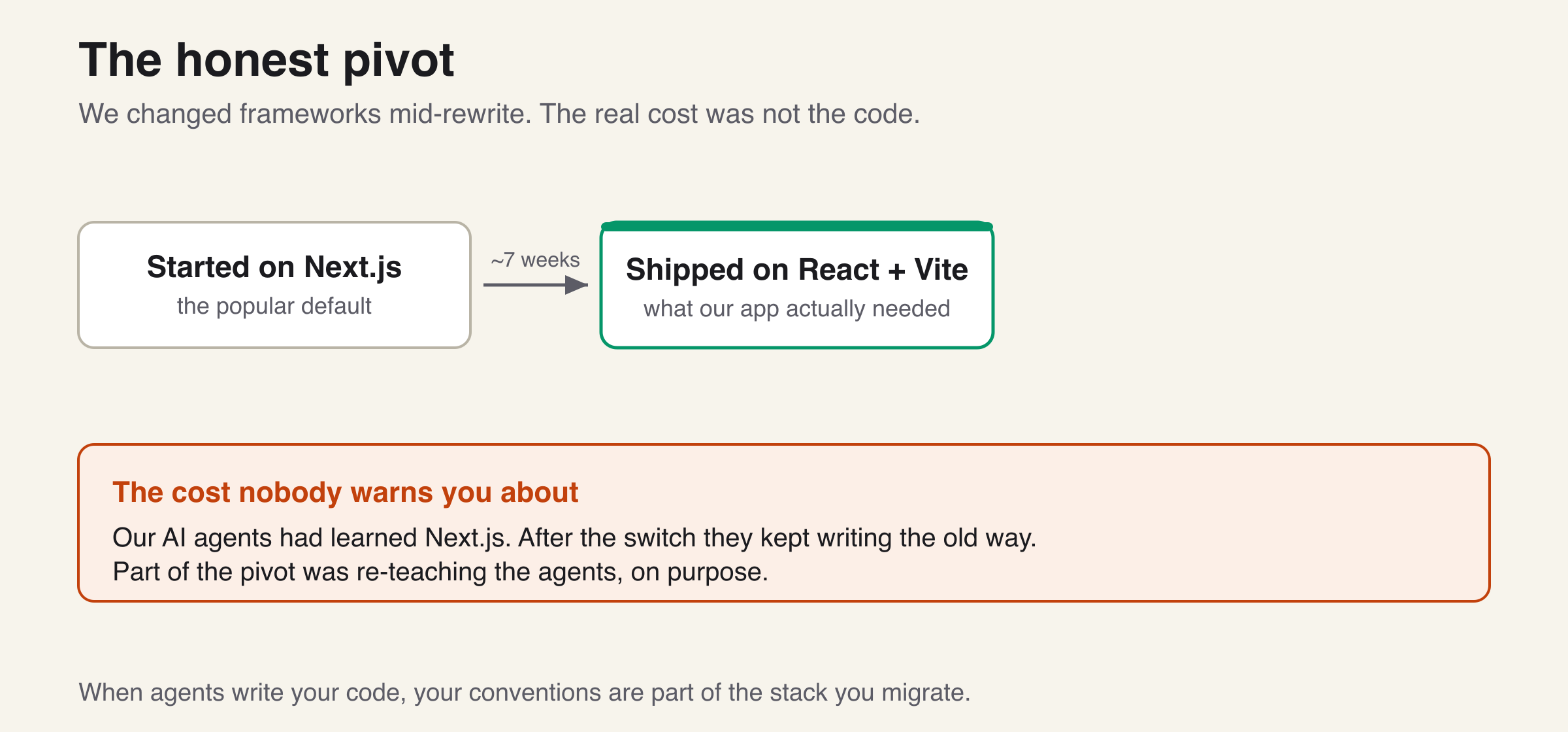
Here is the part I did not expect. By the time we switched, my AI coding agents had learned Next.js. The rules and knowledge I had given them assumed the first framework. So did the conventions they followed. The moment we changed, the agents were confidently writing code for the wrong setup.
So part of the pivot was re-teaching the agents. We corrected the written rules and knowledge from Next.js to React and Vite, and we went through and purged the stale Next.js references so nothing kept pointing the agents the old way. If we had not, they would have kept producing Next.js patterns long after the humans had moved on.
This is a new kind of migration cost. When a person changes direction, they just know. When your code is written by AI agents that follow written rules, changing direction means changing the rules too, on purpose, or the agents keep going the old way. The setup that makes the agents fast is the same setup you now have to migrate. I wrote about how that agent setup works in from prompts to an AI engineering team, and about the rewrite itself in rewriting a live web app from Angular to React in 7 weeks.
What I would tell you
- The popular default is a starting point, not an answer. Ask what your app actually needs before you commit.
- A mid-course pivot is recoverable. Write a checklist for the switch and clean up what the first choice left behind.
- If AI agents write your code, your conventions are part of your stack. When you change direction, migrate the agents' knowledge on purpose, or they will keep building the old way.
Frequently Asked Questions
Further Reading
Tags
Related Articles
Try Our Free Tools
AI Video Prompt Generator
Generate production-ready AI video prompts through conversation. Optimized for Sora 2 and Gemini video generation
AI Video Analyzer
Analyze video content frame-by-frame with AI. Content moderation, security monitoring, accessibility, and product demos
Text Language Detector & Translator
Detect any language and translate text instantly with browser-based AI